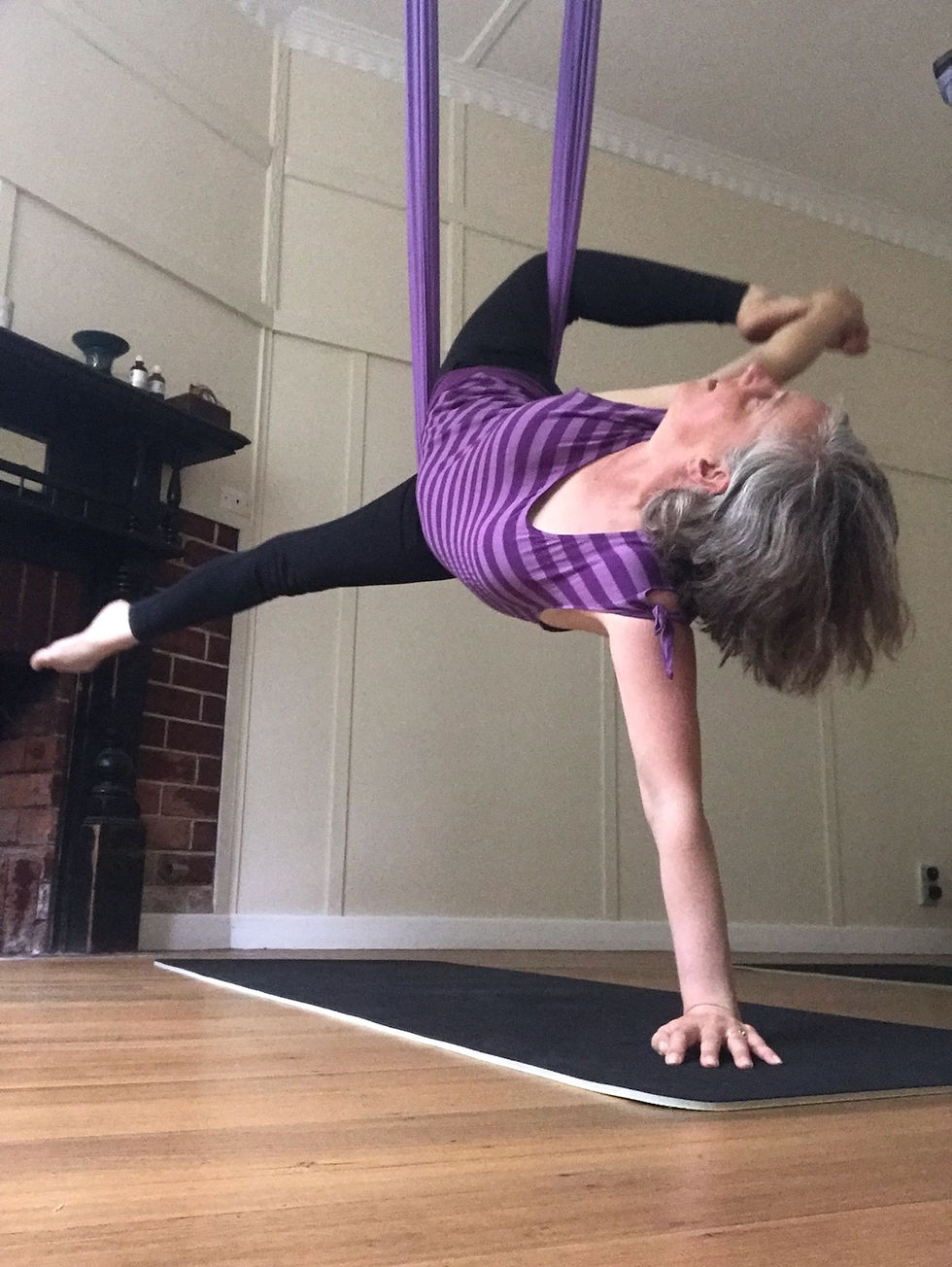

Why try Aerial Yoga?
-
If you like yoga and want to extend your practice
-
If you’ve never tried yoga and want to try a version that’s a bit different
-
If you hate the gym but want to get fit
-
If you want to alleviate muscle tension
-
If you want to stretch further
-
If you want to strengthen your body, especially your core
-
If you’re just starting your fitness journey
-
If you want to relax and relieve stress and tension
-
If you always wanted to run away and join the circus
-
If you want to build confidence by trying new things
-
If you always liked hanging upside down on the monkey bars


Types of Aerial Yoga
Yin Aerial Yoga is very passive, slow-paced practice where the emphasis is on long-held poses to enable the connective tissue to release tension, rather than focusing on muscle flexibility. The body is cradled and supported by the fabric throughout the session, allowing complete relaxation of the targeted body part. Yin is a very gentle, but powerful way to release and strengthen the connective tissue around the joints; ligaments, tendons and fascia. This increases mobility and flexibility of the joints, while promoting deep relaxation throughout the body. Since each pose is held for a long time using the breath to deepen the pose, Yin is a very meditative experience and therefore calming for the mind. Every session is ended with a relaxation/meditation while lying fully in the hammock in savasana.
Yin - Low hammock

Restore (or Restorative) Aerial Yoga takes the same principles of the slow pace of Yin Aerial Yoga, with an added fitness element. Gentle strengthening exercises for the core, upper and lower body are interspersed between calming relaxation poses in this low-intensity class. This class aims to improve concentration and mental health, joint flexibility and mobility, with a gentle activation of the muscles for strength.
Restore - Low hammock

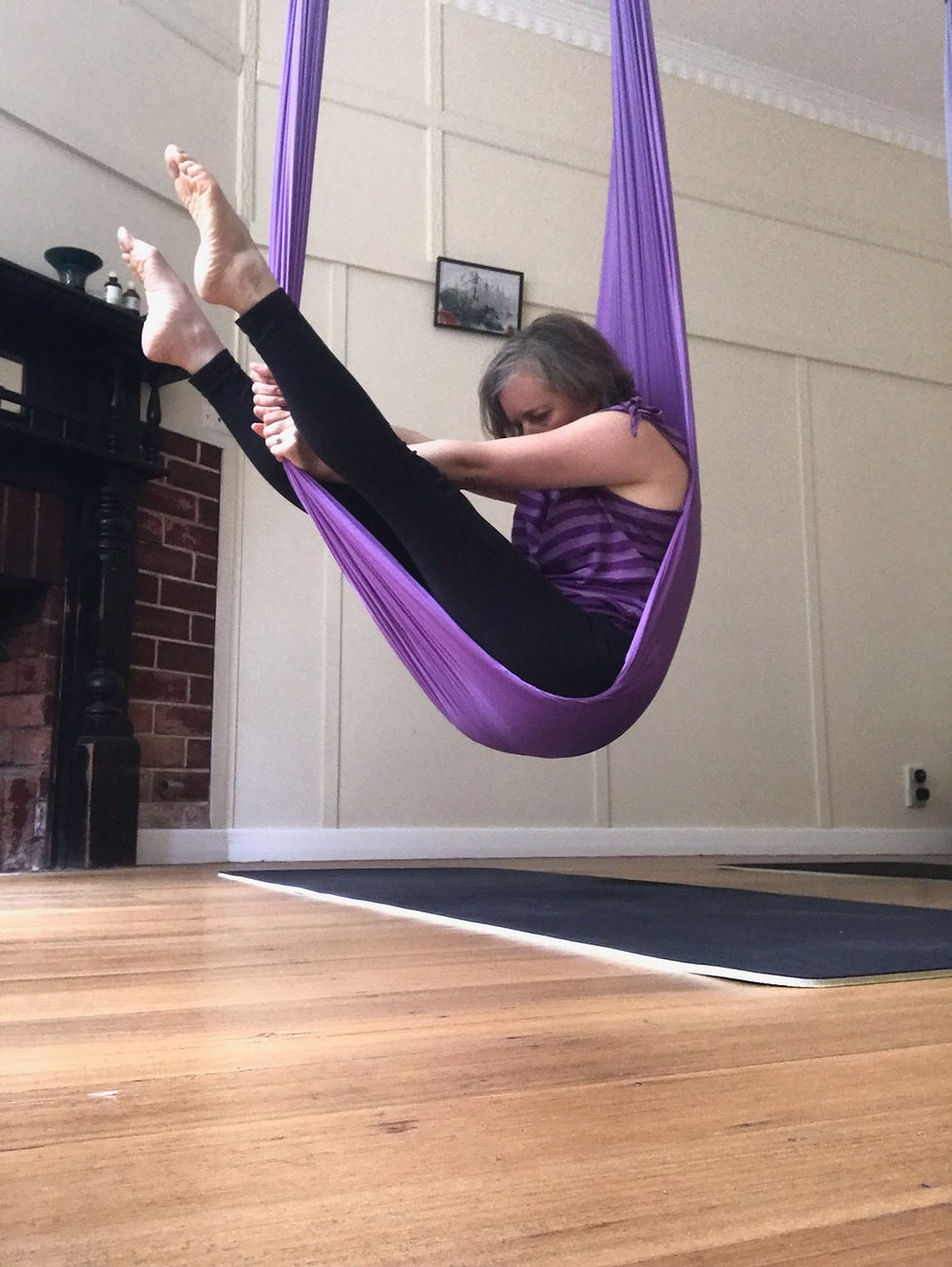
Aerial Yoga uses traditional yoga asanas or poses that have been adapted to the aerial hammock. In this class, you will be guided through the basics of Aerial Yoga poses and introduced to supported inversions which aid in decompressing the spine and releasing tension.
Yoga - Mid height Hammock

A more intense Aerial Yoga class where the focus is on developing strength throughout the body, as well as relaxation, and muscle releasing poses. Stretch further with traction stretches where gravity is drawing you down at the same time that the hammock pulls you up. Feel like a child again as you swing through the air, fully supported by the fabric.
Fitness - Mid height hammock

For those who are comfortable in the hammock and want to experience a more challenging class. Learn stunning poses and sequences as well as flips and tricks.
Artistry - Mid height hammock

Yin - Low hammock

Yin Aerial Yoga is very passive, slow-paced practice where the emphasis is on long-held poses to enable the connective tissue to release tension, rather than focusing on muscle flexibility.
The body is cradled and supported by the fabric throughout the session, allowing complete relaxation of the targeted body part.
Yin is a very gentle, but powerful way to release and strengthen the connective tissue around the joints; ligaments, tendons and fascia. This increases mobility and flexibility of the joints, while promoting deep relaxation throughout the body.
Since each pose is held for a long time using the breath to deepen the pose, Yin is a very meditative experience and therefore calming for the mind.
Every session is ended with a relaxation/meditation while lying fully in the hammock in savasana.
Restore - Low hammock

Restore (or Restorative) Aerial Yoga takes the same principles of the slow pace of Yin Aerial Yoga, with an added fitness element.
Gentle strengthening exercises for the core, upper and lower body are interspersed between calming relaxation poses in this low-intensity class.
This class aims to improve concentration and mental health, joint flexibility and mobility, with a gentle activation of the muscles for strength.
Yoga - Mid height hammock

Aerial Yoga uses traditional yoga asanas or poses that have been adapted to the aerial hammock.
In this class, you will be guided through the basics of Aerial Yoga poses and introduced to supported inversions which aid in decompressing the spine and releasing tension.
Fitness - Mid height hammock

A more intense Aerial Yoga class where the focus is on developing strength throughout the body, as well as relaxation, and muscle releasing poses.
Stretch further with traction stretches where gravity is drawing you down at the same time that the hammock pulls you up. Feel like a child again as you swing through the air, fully supported by the fabric.
Artistry - Mid height hammock

For those who are comfortable in the hammock and want to experience a more challenging class. Learn stunning poses and sequences as well as flips and tricks.

Classes
One-on-one sessions enables a personalised program, making the class as hard or as relaxing as you need it on that day. This also allows modifications to any pose or exercise that you need due to injuries or ability.
Aerial Do's and Don'ts
-
Bring a yoga mat, it is nicer to lie on your own mat. If you don’t have one, don’t worry as one will be provided
-
Wear clothing that is easy to move in.
-
Wear clothing that covers your underarms and knees.
-
Wear clothing that is tighter and longer rather than looser. Jumpsuits or onesies are great
-
Avoid clothes with zippers or other metal that might catch on the fabric
-
Avoid wearing jewellery especially if it’s bulky or dangly or has claw settings that could catch on the fabric
-
Make sure your last meal was at least two hours prior to class– inversions and core workouts with a full belly doesn’t end well
-
Make sure you are well hydrated. It will help to maintain your blood pressure and reduce the chance of dizziness
Inversion Cautions and Contra Indications
Inversions shouldn’t be performed by those who are pregnant, have uncontrolled high or low blood pressure, including glaucoma, and recent surgery or injuries.
Caution should be used by people with hiatus hernia, sinusitis, headache and migraine, vertigo, disc herniation.